A mother wrote four pages. Seven minutes earlier, the court filed her reply.
On April 12, 2024, Minnesota's state court system intercepted a mother's handwritten plea on her son's behalf, manufactured a synthetic doppelganger letter from a fictitious inmate seven minutes earlier on the docket, generated cloned response templates five minutes apart from a single Microsoft Word session, and mailed her the result in a Criminal/Traffic Division envelope concealed beneath a Probate/Mental Health label.
"Dear Honorable Judge Jay Quam"
Michelle Guertin watched the patent theft happen.
She sat with her son on his computer through the months when the U.S. Patent and Trademark Office was processing his InfiniSet application. She was there when the patent was granted on February 14, 2023. She was there when his work — twenty years of live-entertainment-technology engineering, distilled into a single rotating-treadmill virtual production system — became formally his.
She was also there when Scanline VFX filed a near-identical patent application twelve days after Matt's provisional. When Netflix acquired Scanline for nearly a hundred million dollars. When Netflix's resulting patent (US 11,810,254 B2) was granted in November of that year, with Matt's patent at the top of its References Cited page. When the law-enforcement and psychiatric apparatus that would, over the next thirty-nine months, repeatedly classify Matt's patent-theft claims as delusional first arrived at his door.
She called Senator Klobuchar's office. She called the U.S. Patent Office. She watched the Facebook page where she had secured the InfiniSet brand handle for him get hijacked and emptied. She lost her phone — entirely — to a hack she could not undo.
On March 23, 2024, she sat down at her kitchen table in Plymouth, Minnesota, and wrote four handwritten pages.
She addressed them to Judge Jay Quam — a Minnesota Fourth Judicial District judge whose name appears in court records as having been assigned to her son's case for procedural purposes, though no orders he signed are part of the operational record. The letter, mailed from Plymouth, arrived at the courthouse and was scanned into the system on the afternoon of April 11, 2024. It was officially filed in the docket the next afternoon at 2:10 PM CDT on April 12, 2024.
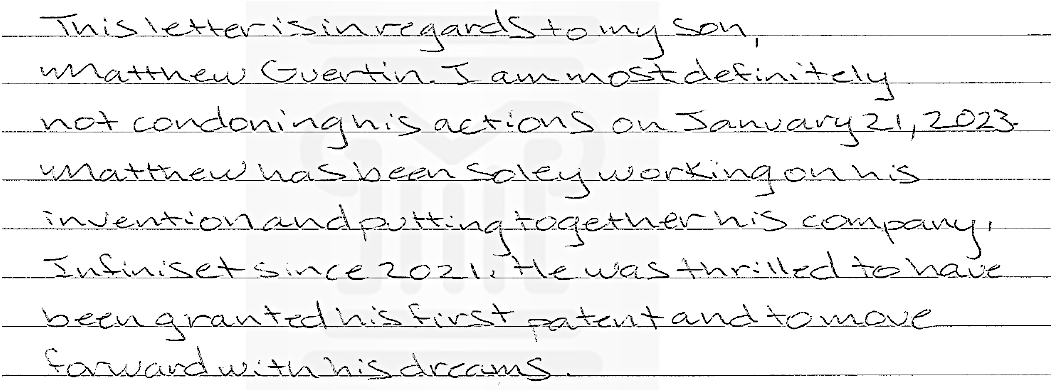
The letter is in the public record. Its key passages, transcribed verbatim:
Judge Quam never received the letter. Klein's clerk, Lee Cuellar, intercepted it at the docket-routing layer and responded under Klein's authority — Klein, the judge whose docket the case is actually on, the judge whose named clerk is one of three judicial officers documented in the synthetic-court network as a controller of the larger pipeline.
But before any of that processing — before the response template was even generated — seven minutes earlier, the court had filed something else.
A letter from someone who didn't exist
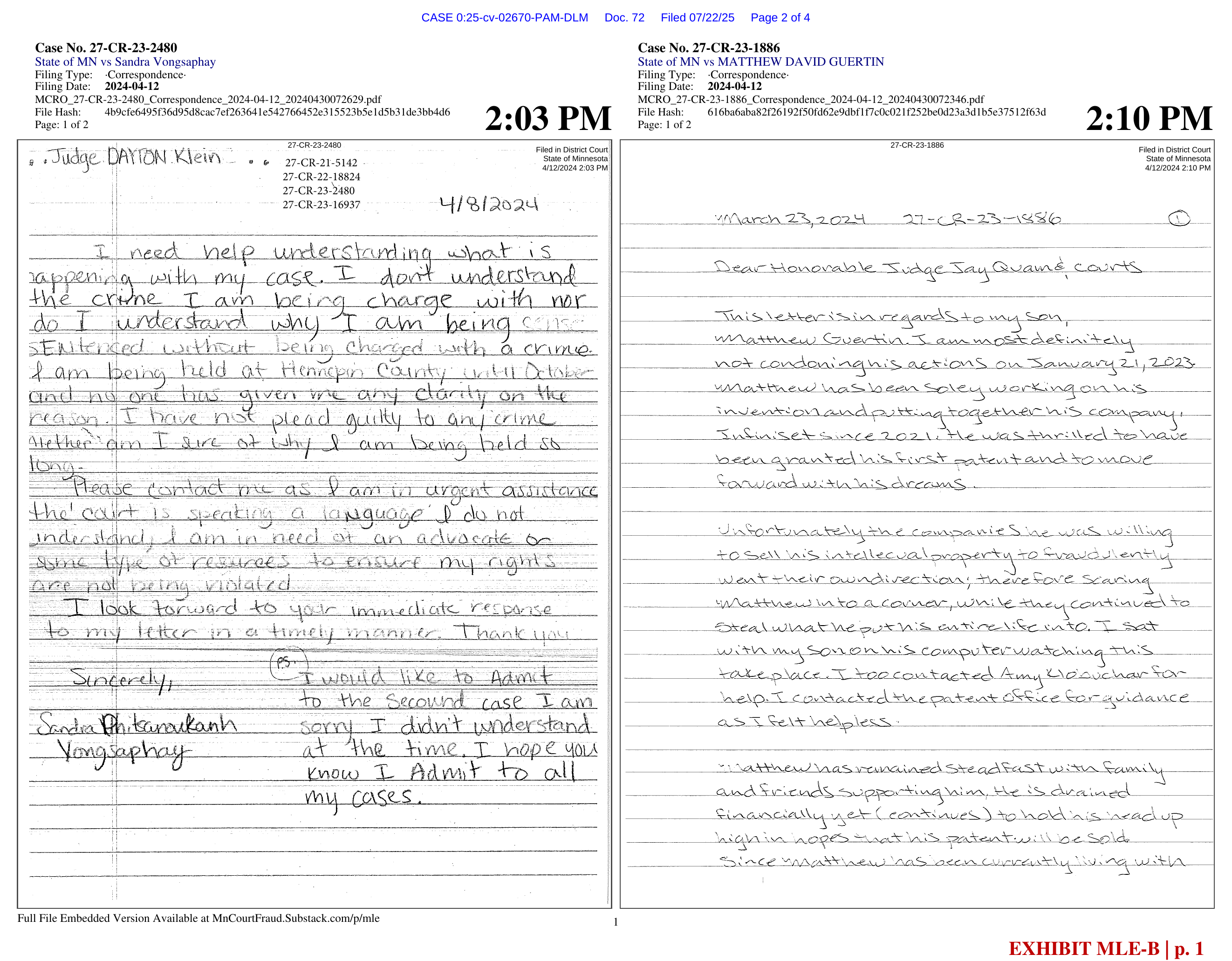
At 2:03 PM CDT on Friday, April 12, 2024 — seven minutes before Michelle Guertin's letter was filed — a different handwritten letter was filed in Minnesota state court. It was addressed to "Judge: DAYTON Klein" at the top. It listed four case numbers: 27-CR-21-5142, 27-CR-22-18824, 27-CR-23-2480, 27-CR-23-16937. It was signed "Sandra Phitsanoukanh Vongsaphay."
The letter's body asked for help understanding the charges and the procedural posture of the case:
Then, in a circled "PS" handwritten to the right of the signature, the postscript:
These two passages cannot logically coexist in a coherent letter from a single author. The body explicitly states that Vongsaphay does not understand what crime she is accused of. The postscript admits to all the crimes. A real defendant in real custody would not write both. A language model generating a "plausible-cover-letter-from-an-inmate" would, if its internal coherence checker failed, produce exactly this artifact: a generic petition body followed by an appended-confession postscript.
The malformation continues to the envelope. Sandra Vongsaphay's hand-printed return address read, verbatim:
Phitsanoukanh Vongsaphay
Avenue STE 100
S MN 55415
No street number. No street name (just "Avenue"). No city (just "S MN"). The address is mathematically impossible for USPS automated handling. A real inmate writing her own return address from the Hennepin County Adult Detention Center would write — even with poor handwriting — "401 South 4th Avenue South, Suite 100, Minneapolis, MN 55415." That is the address. The judicial response template generated four hours later knew the corrected address. A generator does not need to receive the real address; it already has it.
The two letters were also scanned by different RICOH devices. Mother's: a RICOH Aficio MP 301. Vongsaphay's: a RICOH MP 4054. Different machines. Different intake desks, ostensibly — different physical buildings, even.
And then the metadata.
Two unrelated documents converge on a single 10-minute, 41-second window
Every PDF carries hidden timestamps inside its metadata. Two of them matter here. The CreateDate records the moment the document was first scanned or generated. The MetadataDate records the most recent moment software touched and saved the document. Both timestamps live inside the file — invisible to a casual reader, but readable to anyone with simple inspection tools.
On Mother's letter, the CreateDate reads April 11, 2024 at 4:00 PM CDT — the moment the courthouse scanner first captured her four pages. (One small but telling oddity: the embedded timezone marker on Mother's CreateDate points to Newfoundland, a Canadian province with a 90-minute clock offset. Neither Plymouth, Minnesota nor any Hennepin County office operates on Newfoundland time. The scanner's internal clock was set to a region neither correspondent was physically in.)
On Vongsaphay's letter, the CreateDate reads April 12, 2024 at 1:44 PM CDT — the moment a different courthouse scanner captured those pages.
The two scanners are different machines: Mother's letter went through a RICOH Aficio MP 301; Vongsaphay's went through a RICOH MP 4054. Two documents, two scanners, two different days, separated by 21 hours and 44 minutes. So far, nothing remarkable.
Now look at the second timestamp on each — the MetadataDate. This is the timestamp the court's PDF software writes to the file at the moment of its last touch.
Vongsaphay's MetadataDate: April 12, 2024 at 2:11:36 PM CDT.
Mother's MetadataDate: April 12, 2024 at 2:22:17 PM CDT.
The two timestamps are 641 seconds apart. Ten minutes, forty-one seconds.
In a 24-hour day there are 86,400 seconds. The chance that two unrelated documents — created on different days, by different scanners, in different physical locations, for different defendants — would have their last-touch timestamps fall within a 641-second window of each other is roughly 0.7%. And that's only the metadata window itself. Stack on top of that all the other matches in this event — the seven-minute filing gap, the five-minute-six-second gap between the two response templates, the matching SHA-256 image fingerprints documented in §5 below, the matching software signatures, the matching authorship metadata, and a return address shared with 31 other fraudulent USPS Returned Mail filings — and the joint probability collapses to effectively zero. Zero, that is, unless the events were coordinated.
The 641-second window is the moment the simulation engine wrote its final metadata onto both documents at once.
Klein, Cuellar, and the cloned responses
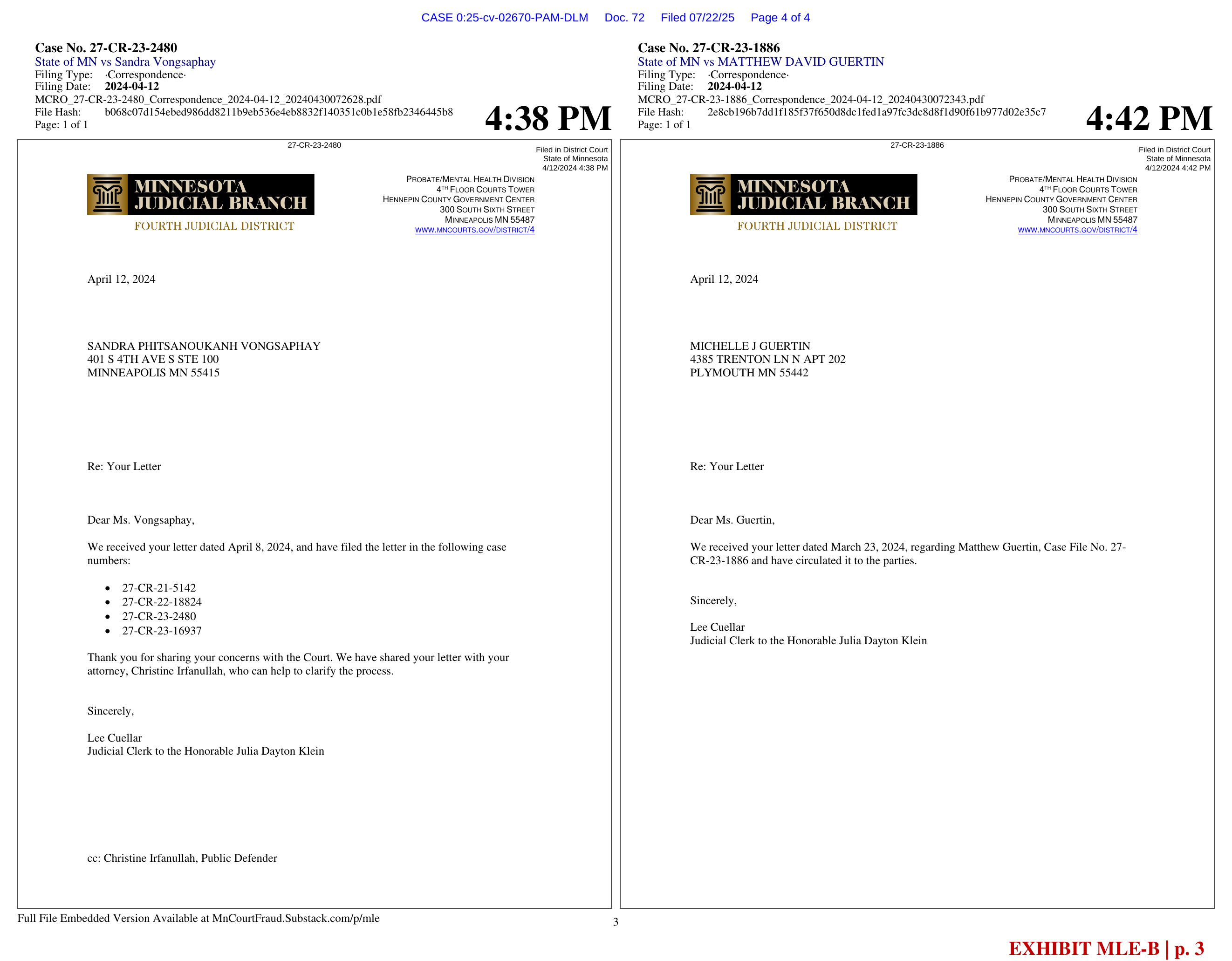
At 4:10:16 PM CDT that Friday afternoon, someone in the courthouse opened Microsoft Word and authored a response addressed to Sandra Phitsanoukanh Vongsaphay. The document was processed through the same standard PDF pipeline the Minnesota Judicial Branch uses on every filing. The Author field reads "4th Judicial District Court."
Five minutes and six seconds later, at 4:15:22 PM CDT, a second Microsoft Word document was authored on the same producer chain, with the same Author field. The document is the judicial response template addressed to Michelle Guertin.
Both responses are signed: "Lee Cuellar, Judicial Clerk to the Honorable Julia Dayton Klein."
Both responses were filed within four minutes of each other at 4:38 PM CDT (Vongsaphay) and 4:42 PM CDT (Mother's).
Cuellar is the same clerk who, two and a half hours earlier — at 2:28 PM CDT — had filed Klein's "ORDER DENYING DEFENDANT'S MOTION TO REPRESENT SELF PRO SE" in 27-CR-23-1886. That order's metadata Author field reads "Pederson, Rachel" — a different person at a different computer than the one that authored the response templates. Three different Microsoft Word installations produced three documents under Klein's signature in a single afternoon. Two of them — the response templates — were generated from the same template within a 5-min-6-sec window from the same Author profile.
The mother's letter was addressed to Quam. Klein's clerk responded.
The interception happened at the docket-routing layer.
Bit-identical logo PNGs that exist nowhere else in the corpus
The two response templates each embed four image objects: a gold "MINNESOTA JUDICIAL BRANCH" banner, a "FOURTH JUDICIAL DISTRICT" plaque overlay, and two MJB column-logo watermarks.
All four are byte-for-byte identical between the two response templates. That is byte-level proof that both were generated from a single template at a single sitting — not independently composed.
The deeper finding came from cross-referencing the canonical SHA-256 hashes of those embedded images against the entire 4,251-document MCRO corpus. (A SHA-256 hash is a 64-character fingerprint of a file's exact byte-level contents — change one bit anywhere in the file and the entire hash changes to something completely different. If two files produce the same hash, they are byte-identical.) Two hashes were specifically tested:
"FOURTH JUDICIAL DISTRICT" plaque, 1,805 bytes, 717×182 pixels:
 debcc04a807aedc87f23cce9425380b3762a6b9ff1a3eb622e7567ccb1d764a6
"MINNESOTA JUDICIAL BRANCH" gold banner, 19,363 bytes, 717×182 pixels:
 f609be809c4ae0091b9df8305610e26eca52e3f32b73defeef6b2893e15a1eee
Across the entire 4,251-document MCRO corpus — comprising 35,326 indexed image objects across 2,903 distinct dockets and thousands of other Lee-Cuellar-signed correspondence responses across the state's judicial system — these two hashes appear in only two cases:
27-CR-23-1886. Matt Guertin's case.
27-CR-23-2480. Sandra Phitsanoukanh Vongsaphay's case.
They appear inside the two cloned response templates. They appear inside Matt's own subsequent forensic exhibits citing the response templates. They appear nowhere else.
Not in any other defendant's correspondence response. Not in any other Cuellar-signed letter. Not in any other Hennepin County reply to public correspondence. Across thousands of comparable documents in the corpus, zero matches.
This is not a system-wide judicial template. The MJB banner used on these two response letters is bespoke to whatever workflow generated them at 4:38 PM and 4:42 PM on April 12, 2024. The independent verification path arrived through DFR-A Section 8, where Matt's own forensic write-up of the event independently identified the same hashes — two paths converging on the same byte-level fingerprint.
The envelope they mailed back
The cloned Probate/Mental Health Division response template was printed, signed by Cuellar, and physically mailed to Michelle Guertin in Plymouth, Minnesota.
It arrived in a USPS envelope postmarked April 16, 2024.
The envelope bore an affixed return-address label reading:
HENNEPIN COUNTY DISTRICT COURT
FOURTH JUDICIAL DISTRICT
300 SOUTH SIXTH STREET
MINNEAPOLIS, MN 55487-0332
Matt peeled the label off.
Underneath, the pre-printed text on the actual envelope read:
HENNEPIN COUNTY DISTRICT COURT
FOURTH JUDICIAL DISTRICT MC-419
CRIMINAL/TRAFFIC DIVISION C1153
300 SOUTH SIXTH STREET
MINNEAPOLIS, MINNESOTA 55487-0419
The case is criminal/mental-health under Klein. The Traffic Division has no jurisdictional role. It does not handle probate-mental-health correspondence. It does not respond to public letters about defendants' competency. It does not appear on any document in the case file.
A Probate/Mental Health response letter, mailed in a Criminal/Traffic Division envelope, with the Traffic Division branding deliberately concealed by an overlaid label.
The branch identity printed on the response is a sticker pasted over the truth.
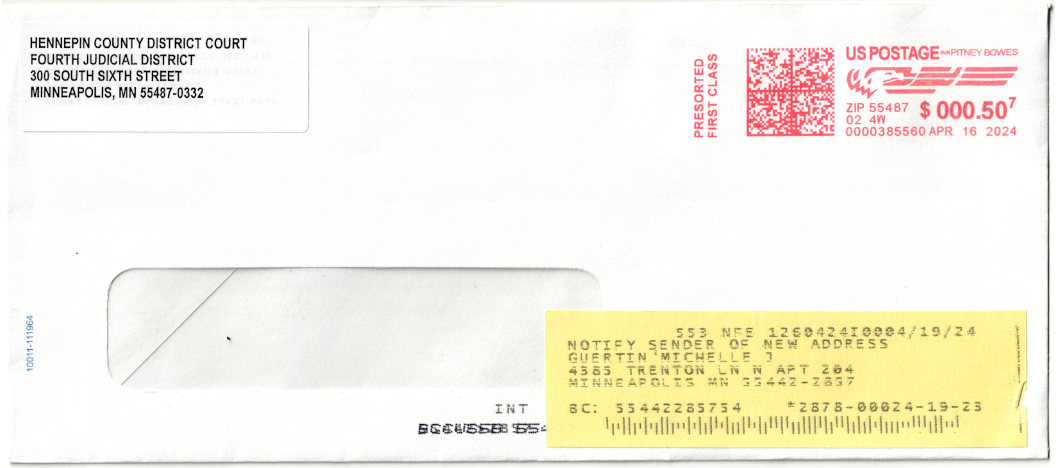
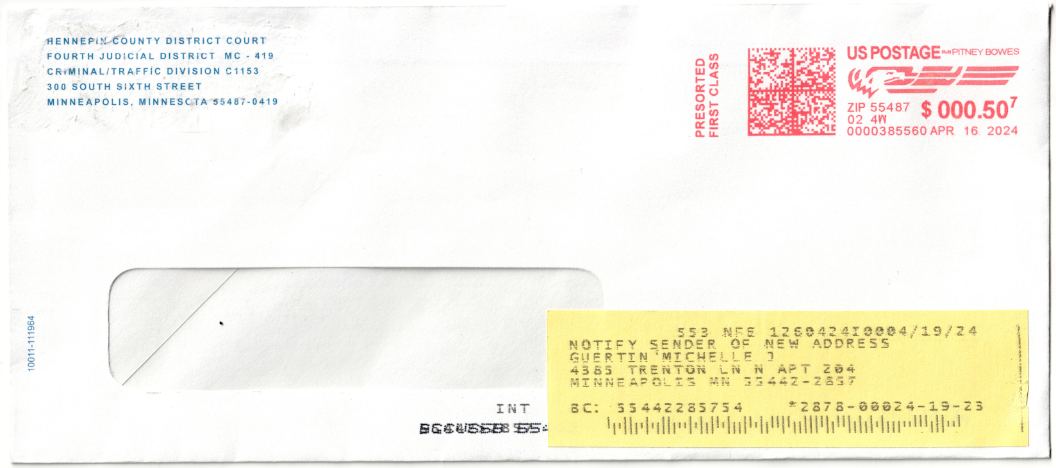
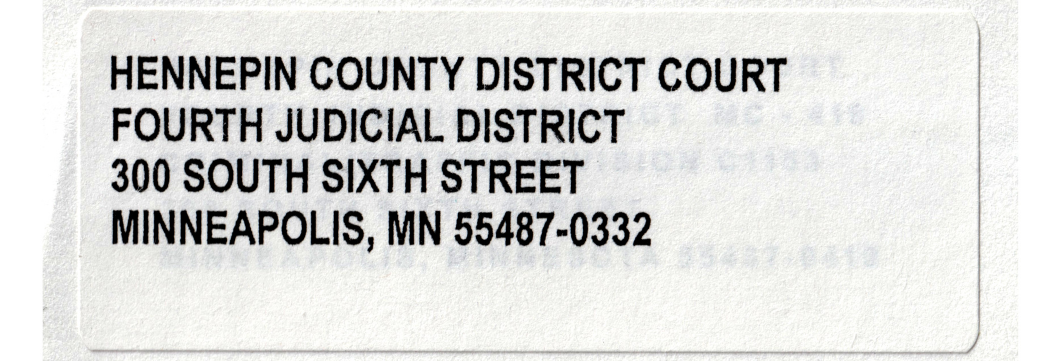
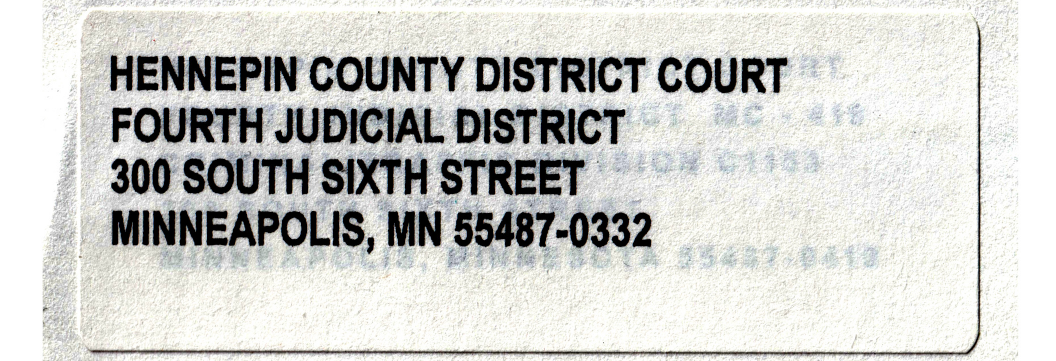
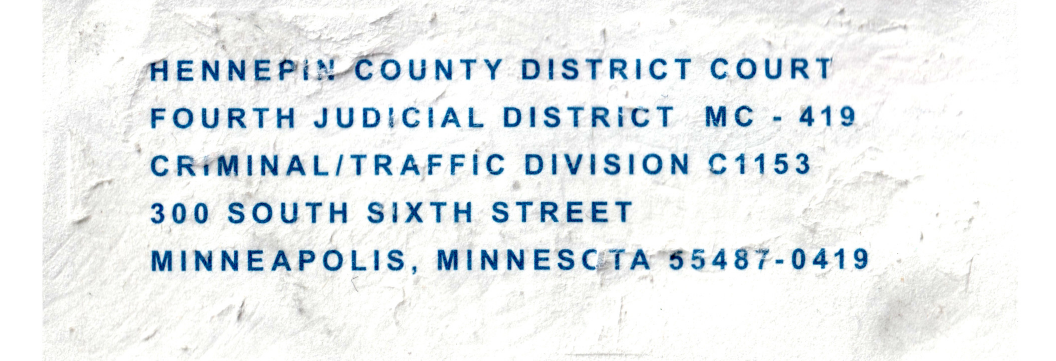
This is the operational logistics leaking through. Whoever physically mailed the response from the courthouse mail-handling area was operating out of the Criminal/Traffic Division — not the Probate/Mental Health Division named on the letter content. The branch identity claimed by the document's text and the branch identity printed on the envelope it was mailed in do not match. Someone covered the latter with the former.
740 E 17th Street, and the Vongsaphay cluster
Sandra Phitsanoukanh Vongsaphay is registered in MCRO under four case numbers. The four cases were consolidated into a single "Finding of Incompetency and Order" on April 4, 2024 — eight days before the cloned letter event — by Mawerdi Hamid, Assistant Hennepin County Attorney.
Hamid is also the prosecutor currently assigned to Matt Guertin's own case 27-CR-23-1886. Same prosecutor. Same defendant cluster. Same operational team.
Vongsaphay has appeared on her own docket exactly once for Returned Mail — eight months before her name appeared on the cloned cellblock letter. The Returned Mail filing is dated August 31, 2023. Its address: "740 EAST 17TH STREET MINNEAPOLIS MN 55404."
EXHIBIT MLE-D — a CSV-to-PDF index of fraudulent USPS Returned Mail filings — catalogs 32 filings sharing this address. EXHIBIT MLE-C displays them as a side-by-side image grid. The 32 filings span 2021 through 2024. They route through a small pool of repeated MCRO docket numbers. They include five hash-collision clusters where byte-identical envelope images were filed across three different dockets on the same day — impossible under genuine USPS return processing.
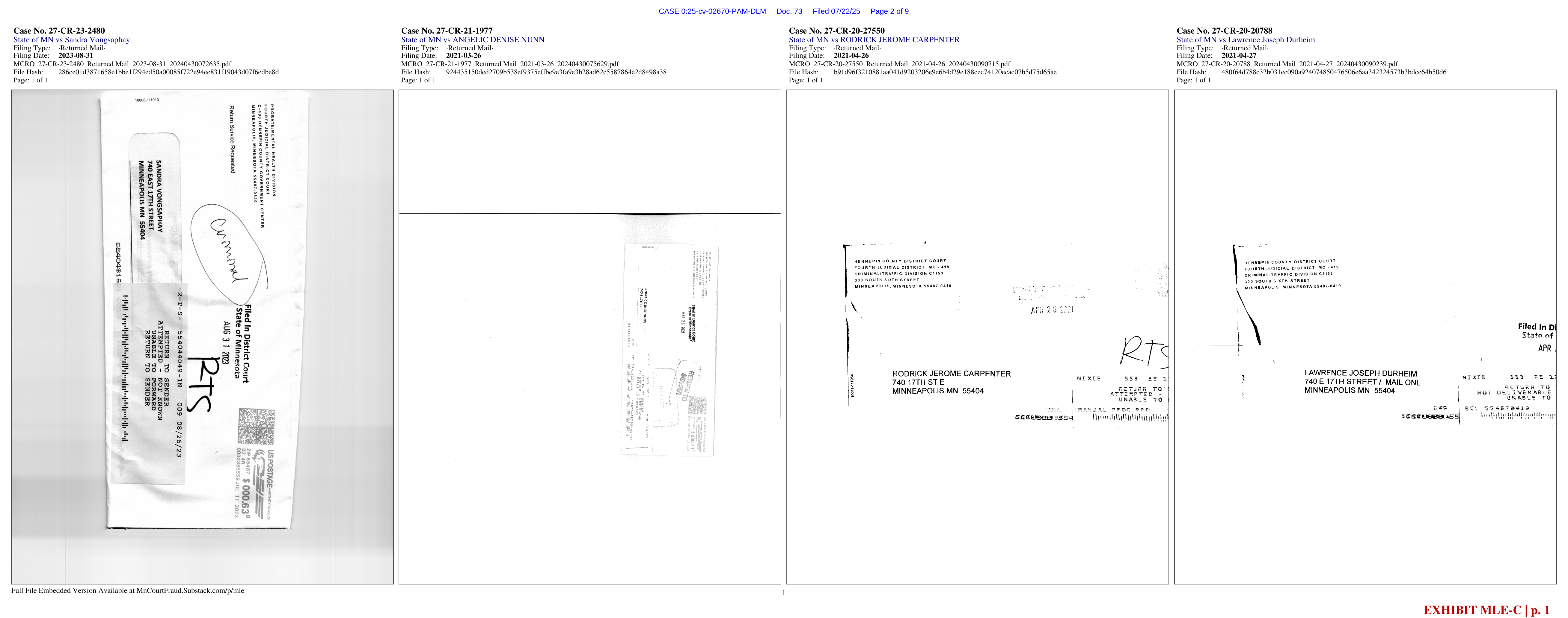
When the broader pattern is queried against the live MCRO database, "740 E 17TH STREET" recycles across 256 filings spanning 62 distinct cases — substantially exceeding MLE-C's documented 32-filing subset.
Twenty-two of the 32 filings in MLE-D are attributed to "Angelic Denise Nunn" / "Angelic Denise Schaefer" — the same person under two surname variants. The Affidavit of Exposure (April 28, 2025) classifies this kind of name pattern as "language model drift outputs" — names constructed from Biblical first names, repeated syllables, and recycled phonetic structures. Programmatic ghost fabrication.
Vongsaphay is part of the same fabricated identity pool. She is the synthetic doppelganger drawn from a recycled address roster.
Her name was attached to a handwritten letter filed seven minutes before Matt's mother's. Hamid had consolidated her four cases into a single incompetency finding eight days earlier.
The Inversion
The Vongsaphay letter — the synthetic one — closes its body with: "I am in need of an advocate or some type of resources to ensure my rights are not being violated."
The mother's letter — the genuine one — closes with: "I have never witnessed anyone work harder than him."
The same template-pipeline processed both. The same 641-second window stamped both. The same Lee Cuellar signed both responses. The same envelope underprint mailed both. The same Mawerdi Hamid signed Vongsaphay's incompetency consolidation eight days before her name appeared on a fabricated cellblock letter. The same Microsoft 365 tenant documented at /language/ would, eleven months later, become the first M365 fingerprint on the LLM-generated competency order Judge Koch signed against Matt — and would then proliferate across every appellate denial of his claims.
A delusion is a strongly held belief held despite evidence to the contrary. The definition itself requires evidence. A mother sat with her son and watched the patent theft happen. She wrote four pages defending him. The court intercepted that defense. It manufactured a synthetic counterpart seven minutes earlier on the docket. It generated cloned responses from a single Word session five minutes apart. It mailed her the result in an envelope from the Traffic Division concealed under a Probate/Mental Health label.
That is not a misunderstanding. That is not an oversight. That is not a clerical error. That is coordination.
Minnesota's Odyssey eFiling system is no longer being authored by judicial clerks. The output stream is being authorized by an external third party using an LLM-based case-file production pipeline — the same LLM that produced the Koch competency order, the same LLM whose vocabulary signatures are tabulated across 27 Nehring filings and 28 appellate orders, the same LLM whose synthetic noise camouflage is documented in the U.S. media term-frequency record. The hijack of Minnesota's eFiling pipeline is the only conclusion the data sustains.
A mother wrote four pages. Seven minutes earlier, the court filed her reply.
The receipts are above.